What is lean? Lean is a way of working that creates more value for the customer with less waste, by removing every step that uses time or resources without adding value. It started in Toyota's car factories, and teams now use it in offices, hospitals, software and startups.
This guide explains who invented lean, the five lean principles, the main types of lean and the core concepts and methods. It ends with a practical way to start, and links to a page for each method.
Key takeaways
- Lean starts with value as the customer sees it, and treats everything else as waste to reduce.
- Lean grew out of the Toyota Production System. The word lean came from researchers at MIT in the late 1980s.
- The five lean principles are value, value stream, flow, pull and perfection, as set out by James Womack and Daniel Jones.
- Methods such as 5S, kanban and value stream mapping are tools for those principles, not the goal themselves.
- A practical start is small: map one process, remove the biggest waste, then repeat.
What is lean methodology?
Lean methodology is a set of principles and methods for improving work by removing waste. Waste is any activity that uses time or resources without adding value for the customer.
The Lean Enterprise Institute describes lean as creating needed value with fewer resources and less waste. It pairs that with constant experimentation toward perfect value with zero waste.
In practice, lean asks three questions of any process. What does the customer value? Which steps create that value? What gets in the way of those steps flowing smoothly?
Who invented lean?
No single person invented lean. It grew out of the Toyota Production System, which Toyota built up over several decades and describes as resting on two pillars: jidoka and just-in-time. The word lean came much later, from researchers who studied Toyota.
1924Sakichi Toyoda
His Type G automatic loom stopped by itself when a thread broke. That idea became jidoka: build quality in by stopping at the first sign of a problem. The jidoka page shows how it works today.
1930sKiichiro Toyoda
When Toyota started making cars, he set out just-in-time: make only what is needed, when it is needed, in the amount needed.
1950s to 1970sTaiichi Ohno
A Toyota production engineer, he turned these ideas into a working system on the shop floor, backed by Eiji Toyoda, who later led the company. His book Toyota Production System describes the result in his own words.
1988John Krafcik
A researcher on MIT's International Motor Vehicle Program, he used the term lean production in a Sloan Management Review article, "Triumph of the Lean Production System".
1990The Machine That Changed the World
James Womack, Daniel Jones and Daniel Roos compared lean production with mass production and brought the term to a wide audience.
1996Lean Thinking
Womack and Jones took lean beyond car making and set out the five lean principles below.
At Toyota Named and written up outside Toyota
The five lean principles
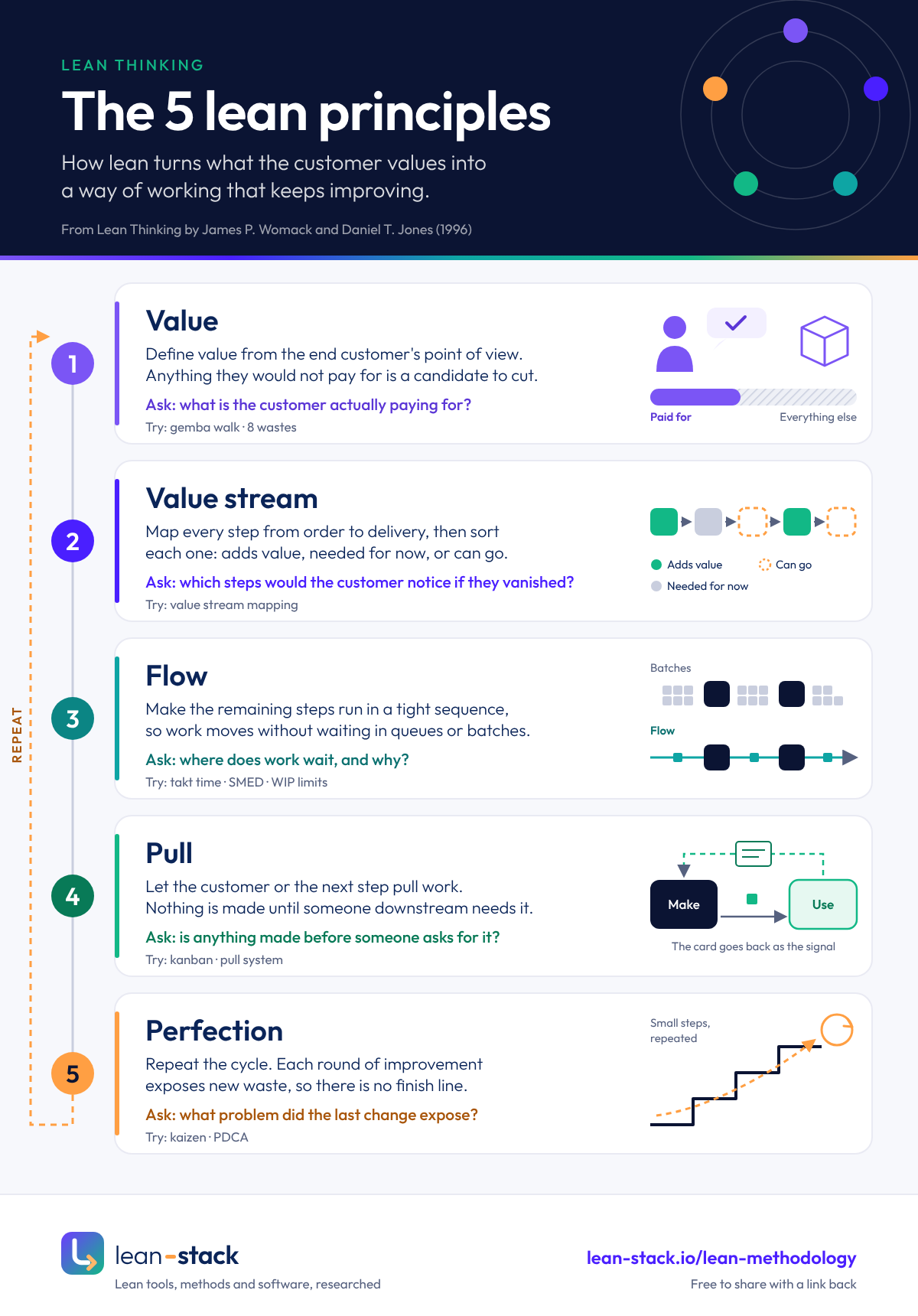
Embed this infographic
Free to use on your site, as long as the credit link stays in place.
In Lean Thinking, Womack and Jones summed up lean in five principles. They are the usual starting point for any lean effort, and each one builds on the one before.
1Value
Value is defined by the end customer, not by the company. For each product or service family, it is what the customer would willingly pay for: the right thing, at the right time, at a price that makes sense to them. Womack and Jones start here because every later step depends on it. A team that misjudges value can build a very efficient process for making the wrong thing.
In practice, this means talking to customers and watching how they use what you deliver. A clinic might learn that patients care most about how long they wait for test results. A software team might find that a report is always exported to a spreadsheet and never read on screen. A gemba walk takes managers to the place where the work happens, so they see this for themselves.
Once value is clear, anything the customer would not pay for becomes a candidate for removal. The eight wastes give names to the usual suspects, such as waiting, rework and overproduction.
One way to make value concrete is to write it from the customer's side. A bookkeeping firm might describe itself as doing monthly bookkeeping. From the client's side, the same service reads: I get accurate numbers by the 5th of each month, so I can decide what to spend. The second version says what to measure: on time, accurate and useful for a decision.
Ask: What is the customer actually paying for?
2Value stream
The value stream is every action needed to bring one product or service from order, or raw material, to the customer. Most teams only see their own part of it. Laying out the whole stream shows the handoffs, queues and approvals between departments, where no single team owns the delay.
Womack and Jones sort the steps into three groups. Some steps create value. Some create no value but are needed for now, because of current equipment, rules or technology. The rest create no value and can be dropped straight away. The middle group is the target of later improvement work.
A value stream map is the standard tool for this. It records each step with its process time and the waiting time before it, so the gap between work and waiting becomes visible. The map often shows that an item spends far more time waiting than being worked on. Value stream mapping software helps keep the map up to date.
Ask: Which steps would the customer notice if they disappeared?
3Flow
With waste taken out of the value stream, the next job is to make the remaining steps run without stopping. Traditional operations group work by department and by batch. Parts wait until a full batch is ready before they move on, and documents sit in an inbox until someone gets to them. Flow means a unit of work moves to the next step as soon as it is ready.
Batches feel efficient for each step but slow down the whole. Every item in a batch waits for the others, and a defect found at the end may affect the entire batch. Smaller batches, and ideally one-piece flow, shorten lead time and bring problems to light sooner.
Several methods support flow. Takt time sets the pace to match customer demand. SMED cuts changeover time so that small batches pay off. Limiting work in progress stops queues from growing, as the guide on why limiting WIP makes teams faster explains, and the Little's Law calculator shows how WIP, throughput and lead time relate.
Ask: Where does work wait, and why?
4Pull
Pull means nothing is made upstream until someone downstream needs it. The opposite, push, builds to a forecast or a schedule and hopes demand matches. When it doesn't, stock piles up in one place while shortages appear in another.
In a pull system, the downstream step sends a signal when it uses something, and the upstream step replaces only that. In a supermarket, the signal is the gap on the shelf. In a factory, it is often a kanban card that travels back to the supplying process. In office and software work, a team pulls the next task only when it has room for it, which is how a kanban board with WIP limits works.
Pull depends on flow. If lead times are long, the signal takes too long to answer and the system falls back on stock, which is why Womack and Jones place pull after flow. The pull system page covers the main designs, and the kanban calculator works out how many cards a loop needs.
Ask: Is anything made before someone asks for it?
5Perfection
The last principle closes the loop. Once value is defined, the stream mapped, flow created and pull in place, the team starts again. Each round removes waste, and with it gone, smaller problems that were hidden before come into view. Womack and Jones describe perfection as a direction to keep moving in, not a state anyone reaches.
This is the role of kaizen, or continuous improvement. Improvement becomes part of normal work, done in small steps by the people closest to the process. PDCA (plan, do, check, act) gives each change a structure: try it on a small scale, check the result, then adopt it or try something else.
Adopted changes go into standard work, the written current method. It is the baseline the next round is measured against, so a team can tell whether a change made things better. Kaizen software can track each idea from suggestion to result.
Ask: What problem did the last improvement expose?
What counts as waste?
Taiichi Ohno grouped the waste he found in mass production into seven types: overproduction, waiting, conveyance, processing, inventory, motion and correction.
Many lean practitioners now add an eighth: talent that the organization does not use. The eight wastes page gives an example of each, from offices as well as factories.
Outside the factory the same wastes take other forms. Some illustrative examples from offices, services and startups:
Overproduction
Building features, reports or stock before anyone asks for them.
Waiting
A proposal sitting in an approval queue, or a support ticket waiting two days for a ten-minute fix.
Conveyance
Files and data passed between several systems or inboxes before anyone works on them.
Overprocessing
More polish or detail than the customer needs, such as heavy formatting on an internal report.
Inventory
Too many projects started and not finished.
Motion
Searching for documents, or switching between tools to finish one task.
Defects
Wrong orders, billing mistakes and bugs that need rework.
Unused talent
Front-line staff who see the problems but have no way to raise them.
Naming waste makes it visible. A team that can see waiting or rework on a board can start to remove it. A good place to look is wherever people say the same thing every week: this always takes too long, or we keep fixing the same issue.
Core lean concepts
A few ideas come up again and again in lean. Knowing them makes the methods easier to follow. The glossary defines each term in more detail.
- Value-added and non-value-added work
- A step adds value only if it changes the product or service in a way the customer cares about. Lean aims to cut the rest.
- Muda, mura and muri
- Muda is waste, mura is unevenness and muri is overburden. Uneven work and overloaded people tend to create waste, so lean tackles all three.
- Just-in-time and jidoka
- The two pillars of the Toyota Production System: make only what is needed, and stop to fix problems at the source.
- Gemba
- The gemba is the place where the work happens. Lean leaders go there to understand a problem, rather than relying on reports.
- Standard work and kaizen
- A standard records the current agreed way to do a job. Kaizen improves it, and the improved method becomes the new standard.
- Respect for people
- Lean depends on the people doing the work to find and solve problems. Toyota names respect for people as one of the two pillars of the Toyota Way, next to continuous improvement.
The core lean methods
Lean has a large toolkit, but a handful of methods do most of the work. Each one links to a page with steps, a worked example and common mistakes.
Seeing the process
Value stream mapping and the gemba walk, which means going to where the work happens.
Organizing the workplace
5S and standard work.
Solving problems
PDCA, A3, five whys and the fishbone diagram.
Aligning the organization
Hoshin kanri, which links yearly goals to daily work.
The full library is on the lean tools page.
Types of lean
The same principles apply wherever work flows through steps. Each field has adapted lean to its own kind of work, and the names below are the ones you will meet most often.
Lean manufacturing
Applies lean to making physical products, where it started. The lean manufacturing guide covers the tools on the shop floor.
Lean office and service
Applies it to administrative and service work, such as approvals, order handling and customer support. The waste there is often waiting, handoffs and rework, hidden in queues and inboxes.
Lean for internal teams
Applies it to finance, HR and purchasing, whose customers are inside the company. A slow hiring approval, invoice sign-off or purchase request holds up everyone downstream. A clear request form, a decision rule and an agreed response time often remove most of the waiting.
Lean healthcare
Applies it to patient care and hospital processes. Virginia Mason in Seattle began building its management system on the Toyota Production System in 2002.
Lean software development
Applies it to building software. Mary and Tom Poppendieck set out the approach in their 2003 book Lean Software Development. Teams use kanban boards, WIP limits and flow metrics.
Lean startup
Applies it to new products under uncertainty, through the build-measure-learn loop that Eric Ries described in The Lean Startup. The lean startup tools hub covers the software for each step.
Lean construction
Applies it to building projects, where the work moves between trades on site. Its methods include the Last Planner System, which plans work with the crews who will do it.
Lean, Six Sigma and agile
The three are often mixed up. Lean works on flow and waste, Six Sigma works on variation and defects with statistics, and agile works on short feedback loops in software and product work. Many organizations combine lean and Six Sigma as Lean Six Sigma.
| Compared | Lean | Six Sigma | Agile |
|---|---|---|---|
| Works on | Flow and waste | Variation and defects | Feedback loops in software and product work |
| Main question | Where does work wait? | Why does the result vary? | Are we building the right thing? |
| Typical tools | Value stream maps, kanban, 5S | DMAIC, control charts, capability studies | Sprints, backlogs, retrospectives |
| Came from | Toyota Production System | Motorola, in the 1980s | The Agile Manifesto, 2001 |
Agile shares lean's focus on small batches, and kanban came to software straight from lean manufacturing.
The guide to lean and Six Sigma explains the differences in more detail.
How to tell if lean is working
Measure the flow of work, not how busy people are. A handful of measures covers most of it, and a team board needs only three or four.
Lead time
From the customer's request to delivery. It is the number the customer feels.
Cycle time
From starting work on an item to finishing it.
Work in progress
How many items are started but not finished. Little's Law links it to lead time: if the team finishes work at the same rate, halving work in progress halves the average lead time.
First pass yield
The share of work done right the first time, without rework.
Throughput
How many items are finished each week.
On-time delivery
The share of promises kept.
Flow efficiency compares the time spent working on an item with its total lead time, and the flow efficiency calculator works it out. Choose measures the team can see every day, and drop any measure that rewards hiding problems or rushing work.
Why lean efforts stall
The principles are simple to state, and the methods are well documented. Lean efforts still stall, and the reasons tend to repeat. Knowing them in advance is cheaper than finding them out.
1The tools arrive without the problem
A plant runs 5S on every area or a team installs a kanban board because lean says so, not because a customer problem calls for it. Once the first round is done, nobody can say what the effort was for, and it fades. Start from a problem the customer feels, and pick the tool that fits it.
2Improvement sits outside normal work
A kaizen event or a training wave produces a burst of change, then everyone goes back to the day job. Without a daily routine that surfaces problems and assigns owners, the gains slip back. This is why daily management and standard work matter as much as the event itself.
3Leaders delegate it
Lean asks managers to go to the gemba, ask questions and coach, which takes their time every week. When it is handed to a project office or a consultant, people read it as a program that will end. The lean management guide covers what leaders do differently in a lean system.
4Efficiency is measured in the wrong place
Local measures, such as machine use or tickets closed per person, reward big batches and busy people. Lean improves the flow of the whole value stream, so a step may look less efficient while lead time for the customer falls. If the measures do not change, the old behavior comes back.
5Cutting waste turns into cutting people
If the first visible result of lean is job losses, the people closest to the work stop pointing out waste. A common safeguard is an early, public commitment that improvement will not cost anyone their job, with freed-up people moved to new work instead.
How to start with lean
Start with one process that matters to a customer and that the team can change. A month is enough for a first full cycle. Here is one way to plan it.
- Days 1 to 5
Pick and define
Choose the process, and write down where it starts and ends, who works in it and what the customer gets from it. Keep the scope small enough to walk through in an hour.
- Days 6 to 10
See the work
Follow real requests through the process and draw it on paper first, as the guide on value stream mapping on paper suggests. Mark waiting, rework and handoffs, and ask the people doing the work what slows them down.
- Days 11 to 15
Choose one target
Pick the biggest waste you can see, and say what better looks like in numbers, such as a shorter lead time or fewer returns.
- Days 16 to 23
Test one change
Run a small PDCA experiment, such as a checklist, a WIP limit or one approval fewer. Measure before and after.
- Days 24 to 30
Hold the gain and pick the next target
If the change worked, write it into standard work. If it didn't, record what the team learned and adjust the test.
Illustrative example
A five-person accounting team picks its month-end close, which takes 9 working days. The map shows that 3 of those days go to waiting for receipts from other departments. The team tests a receipt cutoff, with a reminder 2 days before month end. The next close takes 7 days, so the cutoff becomes the standard, and the next target is rework from miscoded expenses.
After the first month, make problems visible every day. A short daily huddle at a board, with clear owners for each issue, keeps improvement going after the first project.
Add software only when paper limits you. The lean manufacturing and lean management guides cover what to use, and when.
Frequently asked questions
What are the 5 principles of lean?
What is the main goal of lean methodology?
What are the 8 wastes of lean?
Can lean methodology be used outside manufacturing?
Is lean the same as Six Sigma?
How long does it take to implement lean?
Guides on this topic
- Process improvement methodologies: 9 methods comparedProcess improvement methodologies compared: PDCA, lean, kaizen, Six Sigma, TQM, theory of constraints, BPR and retrospectives, with how to choose and combine.Read the guide
- Lean thinking: the 5 principles and the mindsetLean thinking is a way of creating value with less waste. Learn the five principles, the lean mindset, how it differs from lean tools and how managers apply it.Read the guide
- Lean construction: principles, techniques and how to startLean construction applies lean thinking to building projects. Learn the principles, the eight wastes on site, the Last Planner System and how to start.Read the guide
- Lean product development: principles, set-based design, A3sLean product development explained: principles, set-based concurrent engineering, the chief engineer system, A3s, trade-off curves and ties to lean startup.Read the guide
Sources
Books and papers show their publication year. Web pages show the month we last checked them.
- 1.James P. Womack and Daniel T. Jones, Lean Thinking: Banish Waste and Create Wealth in Your Corporation (Simon & Schuster, 1996)
- 2.James P. Womack, Daniel T. Jones and Daniel Roos, The Machine That Changed the World (Rawson Associates, 1990)
- 3.John F. Krafcik, Triumph of the Lean Production System (Sloan Management Review 30(1), Fall 1988)
- 4.Taiichi Ohno, Toyota Production System: Beyond Large-Scale Production (Productivity Press, 1988)
- 5.Toyota Motor Corporation, Toyota Production System (global.toyota, checked October 2026)
- 6.Lean Enterprise Institute, What is Lean? (lean.org, checked October 2026)
- 7.Jeffrey K. Liker, The Toyota Way: 14 Management Principles from the World's Greatest Manufacturer (McGraw-Hill, 2004)
- 8.Mary Poppendieck and Tom Poppendieck, Lean Software Development: An Agile Toolkit (Addison-Wesley, 2003)
- 9.Eric Ries, The Lean Startup (Crown Business, 2011)
- 10.Charles Kenney, Transforming Health Care: Virginia Mason Medical Center's Pursuit of the Perfect Patient Experience (Productivity Press, 2011)
- 11.Glenn Ballard, The Last Planner System of Production Control (PhD thesis, University of Birmingham, 2000)